





Дифракция отраженных электронов в растровом электронном микроскопе
Определение твердости образцов из цементированной и индукционно-закаленной стали в процессе термообработки
Оборудование для определения твердости - неотъемлемая часть цехов закалки стали - позволяет вести контроль качества изделий из цементированной и индукционно-закаленной стали.
Проблемы определения твердости керамических материалов
В таких сферах, как разработка медицинской продукции, автомобильная или электронная промышленность, широко применяется керамика технического назначения — не только для изготовления деталей, но и в качестве покрытия с высокой стойкостью к износу и высоким температурам, не подверженного коррозии и не обладающего проводящими свойствами. Помимо таких свойств, как низкая плотность и низкое тепловое расширение, керамические изделия демонстрируют высокую твердость, но при этом низкую стойкость к растрескиванию и высокий модуль упругости. Эти механические свойства позволяют использовать керамические изделия при изготовлении конденсаторов, изоляторов, форсунок или лопастей, подшипников, компонентов насосов, а также покрытий для металлических деталей.
Пробоподготовка образцов после тормообработки
В сталелитейной промышленности воспроизводимые, надежные и сопоставимые результаты являются обязательными для создания высококачественных стальных изделий. Для эффективного управления процессом производства необходимо проверить большое количество образцов, для этого процесс подготовки одного образца должен быть простым и быстрым. Кроме того, в процессе подготовки необходимо обеспечить плоскоскую поверхность образца для последующего легкого и безошибочного изучения поверхности.

Ensuring high quality in the additive manufacturing process
Additive manufacturing, as well as powder injection molding, offer great potential if the raw materials employed are of optimum quality. But the process needs to be continuously monitored, and the finished parts need to be examined meticulously to ascertain the relevant parameters for a high-quality, cost-efficient production process.

Hardness Testing in Powder Metallurgy
Hardness testing in powder metallurgy requires completely different parameters and procedures compared to classic hardness testing applications. Samples have to be prepared well to enable the hardness test. Powder has to be embedded in resin, e. g. with a hot mounting press, and afterwards the materialographic specimen has to be polished to obtain a clean surface for hardness testing.
Hardness testing on steel
Hardness testing is indispensable for hardening shops to assess the quality of casehardened or induction-hardened parts. QNESS hardness testers make this an easy task thanks to the unique Qpix Control2 hardness testing software and its 3D and visualization features.
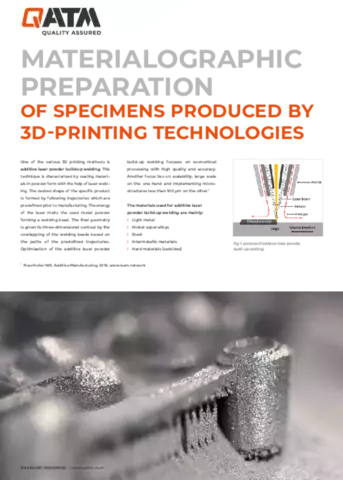
Materialographic Preparation of Specimens Produced by 3D-Printing Technologies
One of the various 3D printing methods is additive laser powder build-up welding. This technique is characterized by coating materials in powder form with the help of laser welding. The desired shape of the specific product is formed by following trajectories which are predefined prior to manufacturing. The energy of the laser melts the used metal powder forming a welding bead. The final geometry is given its threedimensional contour by the overlapping of the welding beads based on the paths of the predefined trajectories. Optimization of the additive laser powder build-up welding focuses on economical processing with high quality and accuracy.
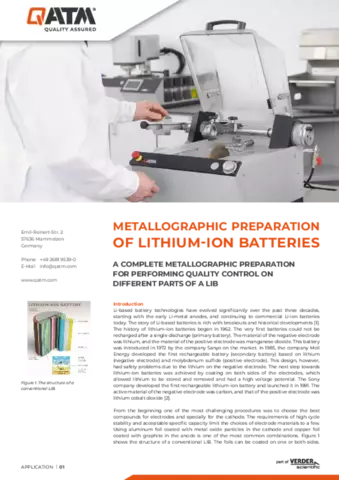
Metallographic Preparation of Lithium-Ion Batteries
One of the procedures for the quality control of LIBs is metallographic investigation of the cap and case of the battery, the spot welding or the electrodes. Since these parts are made of different materials, they require different preparation methods. This article explores the various preparation methods as well as the target of each preparation and discusses the results.
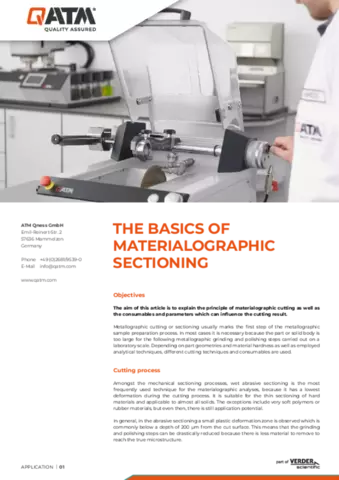
The Basics of Materialographic Sectioning
Metallographic cutting or sectioning usually marks the first step of the metallographic sample preparation process. In most cases it is necessary because the part or solid body is too large for the following metallographic grinding and polishing steps carried out on a laboratory scale. Depending on part geometries and material hardness as well as employed analytical techniques, different cutting techniques and consumables are used. The aim of this article is to explain the principle of materialographic cutting as well as the consumables and parameters which can influence the cutting result.