





EBSD Gefügeuntersuchung mittels SEM
Die Elektronenrückstreuungsbeugungstechnik (EBSD) - ein leistungsstarkes Werkzeug zur Untersuchung von Mikrostrukturen mittels SEM (Rasterelektronenmikroskopie)

Härteprüfung in der Pulvermetallurgie
Die Härteprüfung in der Pulvermetallurgie verlangt komplett andere Parameter und Verfahren als klassische Härteprüfanwendungen. Die Proben müssen für die Härteprüfung entsprechend aufbereitet werden.

Höchste Qualität bei Additiver Fertigung ermöglichen
Die Additive Fertigung wie auch das Pulverspritzgießen bieten großes Potential, wenn die eingesetzten Materialien von optimaler Qualität sind. Aber auch der Prozess muss kontinuierlich überwacht und die fertigen Bauteile müssen sorgfältig geprüft werden, um so die relevanten Kenngrößen für eine qualitativ hochwertige, kosteneffiziente Produktion zu ermitteln. Die in diesem Beitrag genannten Unternehmen der Verder Scientific Division bieten hierfür zuverlässige und kundenfreundliche Lösungen an.
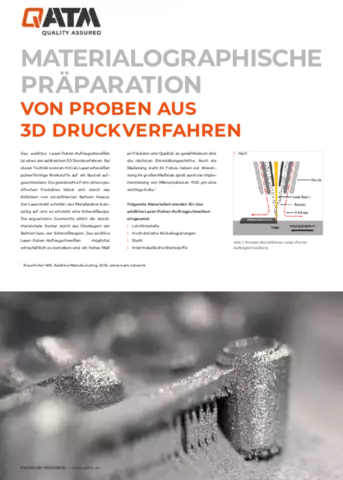
Materialographische Präparation von Proben aus 3D Druckverfahren
Das additive Laser-Pulver-Auftragschweißen ist eines der zahlreichen 3D Druckverfahren. Bei dieser Technik werden mittels Laserschweißen pulverförmige Werkstoffe auf ein Bauteil aufgeschmolzen. Die gewünschte Form eines spezifischen Produktes bildet sich durch das Abfahren von vordefinierten Bahnen heraus.
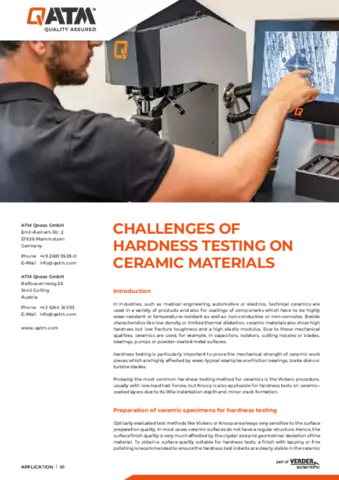
Hardness testing on Ceramics
Next to applications on steel and non-ferrous metals hardness testing on ceramic materials is an interesting and challenging application for any hardness tester. High hardness values and low fracture toughness are typical characteristics of technical ceramics. With advanced optic system quality and unique universality QNESS hardness testers can make daily hardness testing on ceramics a lot easier for the operator.
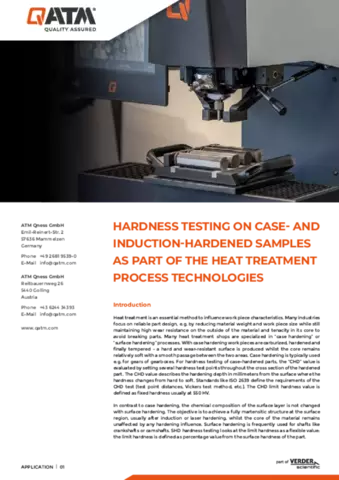
Hardness testing on steel
Hardness testing is indispensable for hardening shops to assess the quality of casehardened or induction-hardened parts. QNESS hardness testers make this an easy task thanks to the unique Qpix Control2 hardness testing software and its 3D and visualization features.
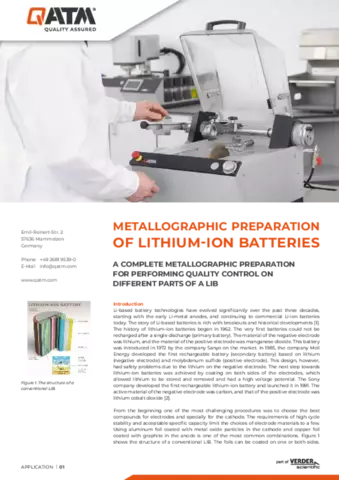
Metallographic Preparation of Lithium-Ion Batteries
One of the procedures for the quality control of LIBs is metallographic investigation of the cap and case of the battery, the spot welding or the electrodes. Since these parts are made of different materials, they require different preparation methods. This article explores the various preparation methods as well as the target of each preparation and discusses the results.
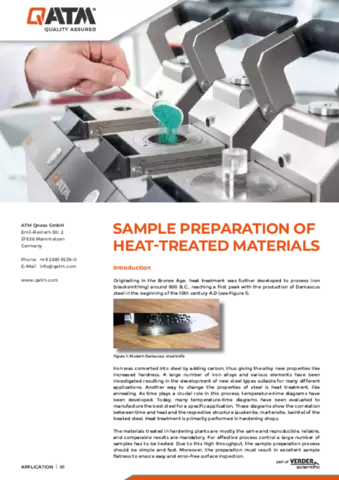
Sample Preparation of Heat-Treated Materials
In hardening plants, reproducible, reliable and comparable results are mandatory to create high-quality steel products. For effective process control a large number of samples has to be tested. Due to this high throughput, the sample preparation process should be simple and fast. Moreover, the preparation must result in excellent sample flatness to ensure easy and error-free surface inspection.
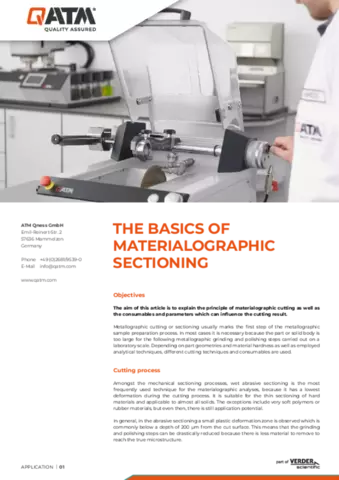
The Basics of Materialographic Sectioning
Metallographic cutting or sectioning usually marks the first step of the metallographic sample preparation process. In most cases it is necessary because the part or solid body is too large for the following metallographic grinding and polishing steps carried out on a laboratory scale. Depending on part geometries and material hardness as well as employed analytical techniques, different cutting techniques and consumables are used. The aim of this article is to explain the principle of materialographic cutting as well as the consumables and parameters which can influence the cutting result.
Определение твердости образцов из цементированной и индукционно-закаленной стали в процессе термообработки
Оборудование для определения твердости - неотъемлемая часть цехов закалки стали - позволяет вести контроль качества изделий из цементированной и индукционно-закаленной стали.